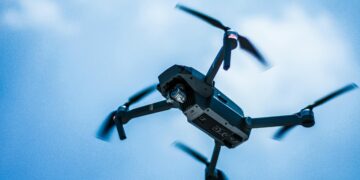




Drones have shifted from niche tools to widely accessible platforms with real-world implications for security, surveillance, and disruption. They are small, fast, and capable of operating in environments that were never designed for traditional airspace monitoring. In dense urban areas, industrial zones, or critical infrastructure sites, drones can move through cluttered environments with minimal visibility and almost no warning.
This creates a fundamental problem: Most legacy air surveillance systems were built to track large, high-altitude aircraft with predictable flight patterns. They struggle with low-altitude, low radar cross-section (RCS) targets moving unpredictably through buildings, terrain, and signal noise. The result is a detection gap that modern drone detection technology must close.
Today’s approach is not based on a single sensor. It relies on layered detection systems built around two core technologies: radar and RF signal detection. These systems operate differently and observe separate aspects of drone activity. When combined, they create a complete picture of what’s happening in the airspace.
Why Drone Detection Is Technically Challenging
Drone detection is difficult because they are engineered to be hard to detect.
Most commercial and semi-professional drones operate at low altitudes, often below traditional radar coverage. They move at relatively low speeds, which makes them harder to distinguish from environmental noise. More importantly, they have an extremely small radar cross-section, often around 0.01 m², which means they reflect very little energy back to traditional radars.
Beyond physical characteristics, drones blend into two major types of noise:
- Environmental noise: Birds, debris, buildings, terrain reflections
- Electromagnetic noise: Wi-Fi networks, communication signals, and RF congestion
To complicate things further, most drones rely on commercial communication protocols such as Wi-Fi, proprietary telemetry links, or digital video transmission. These signals are not inherently suspicious; they exist everywhere.
Because of this, modern drone detection systems rely on two distinct methods:
- Radar systems, which detect physical objects in motion.
- RF signal detectors, which detect communication activity.
Each method has its strengths and blind spots.
How Radar-Based Drone Detection Works
Detecting Physical Objects in Motion
Radar-based drone detection works by emitting electromagnetic waves and analyzing the signals reflected back from objects in the environment. The challenge is simple: Small drones reflect very little energy, making them difficult to detect reliably.
Modern drone radar detection systems are engineered specifically to detect low-RCS targets. For example, systems designed for drone detection can reliably identify objects with radar cross-sections as small as ~0.01 m², which is typical of consumer drones.
3D Pulse Doppler and Target Differentiation
The key advancement in drone radar is the use of 3D pulse Doppler technology.
Pulse Doppler radar filters out stationary clutter, such as buildings, terrain, and static infrastructure. Instead of seeing “everything,” it focuses on moving objects, which is critical for isolating drones from background noise.
This enables real-time tracking of:
- Speed
- Direction
- Distance
- Altitude
The ability to measure altitude is especially important. In low-altitude environments, radar altitude becomes a defining parameter for threat assessment, helping operators distinguish between ground-level noise and airborne targets.
3D Spatial Awareness and Tracking
Modern radar systems don’t just detect; they map the airspace.
Using azimuth scanning (horizontal) combined with pitch phase scanning (vertical), they create a full 3D representation of the environment. This allows continuous tracking of drone movement across both horizontal and vertical planes.
This level of spatial awareness enables:
- Real-time trajectory tracking
- Multi-target monitoring
- Predictive movement analysis
Strengths of Drone Radar Systems
Radar-based drone detection offers a critical advantage: it does not rely on the drone transmitting any signal. This means it can detect:
- Autonomous drones
- Pre-programmed flight paths
- Signal-silent or modified drones
It also performs reliably in:
- Day and night conditions
- Fog, haze, and poor visibility
- Complex terrain
In short, radar answers one question extremely well: “Is there a physical object in the airspace?”
How RF Signal Detection Identifies Drones
While radar detects physical presence, RF detection systems detect activity.
Most drones rely on radio frequency communication for:
- Control signals (pilot to drone)
- Telemetry (drone to controller)
- Video transmission
RF detection systems monitor these signals across a wide frequency spectrum to identify drone-related activity.
Full-Band Signal Monitoring
Modern RF signal detector systems operate across broad frequency ranges. For example, full-band RF detection systems monitor from 300 MHz to 6 GHz, covering:
- Remote control signals
- Data transmission
- Wi-Fi-based drone communication
This allows the detection of the vast majority of consumer and semi-professional drones.
Signal Analysis and Identification
RF detection is not just about detecting signals. It’s about understanding them. Advanced RF detection systems analyze signal patterns to extract:
- Drone model identification
- Unique serial numbers (e.g., DJI drones)
- Telemetry data (location, altitude, speed, direction)
This transforms raw RF data into actionable intelligence.
Direction Finding and Positioning
RF detection systems use techniques such as:
- Angle of Arrival (AOA)
- Time Difference of Arrival (TDOA)
These enable:
- Drone location tracking
- Pilot/controller location detection
In multi-station deployments, this becomes highly precise, enabling full spatial mapping of both the drone and the operator.
Passive Detection Advantage
Unlike radar, RF detection systems operate passively. They do not emit electromagnetic signals.
This creates several operational benefits:
- No detectable footprint
- Reduced risk of interference
- Ideal for covert or sensitive deployments
RF detection systems answer a different question than radar: “What signals are present, and what do they mean?”
Radar vs. RF Detection: What Each Technology Sees
Radar and RF detection systems operate on fundamentally different principles.
Radar detects:
- Physical objects in the airspace
- Movement and trajectory
- Altitude and speed
RF detects:
- Communication signals
- Drone identity and model
- Operator activity and intent
The critical takeaway is this: Neither system provides absolutely complete visibility on its own.
Radar cannot identify a drone’s origin or operator. RF cannot detect a drone that is not transmitting.
Why Modern Anti-Drone Systems Combine Radar and RF Detection
Eliminating Blind Spots
Combining radar and RF detection provides complementary information, offering a more complete picture than either system alone.
- Radar detects drones with no active signals.
- RF detects drone activity before takeoff (controller signals).
This creates continuous coverage across the entire drone lifecycle.
Cross-Verification of Targets
Multi-sensor detection improves accuracy.
- Radar confirms a physical object.
- RF confirms identity and communication behavior.
This reduces uncertainty and increases confidence in threat classification.
Improved Accuracy in Complex Environments
Urban and high-interference environments benefit significantly from sensor fusion.
- Reduces false positives (e.g., birds vs. drones)
- Filters out irrelevant RF noise
- Enhances detection reliability
This is where modern drone detection technology becomes operationally viable at scale.
Real-World Deployment Considerations
Detection capability alone is not enough. Deployment strategy determines effectiveness.
Single-Station vs. Multi-Station
- Single-station deployments: Faster setup, lower cost
- Multi-station deployments: Higher accuracy, full spatial coverage, scalable
RF detection systems, in particular, benefit from multi-station configurations for precise TDOA-based positioning.
Coverage and Scalability
Drone detection systems must scale based on:
- Area size
- Threat level
- Environmental complexity
Systems should support flexible expansion without major infrastructure changes.
Environmental Adaptability
Effective drone detection systems must operate in:
- Adverse weather conditions
- Dense urban RF environments
- Remote or rugged terrain
Both radar and RF technologies are designed for 24/7, all-weather operation, ensuring continuous monitoring.
Integration with Defense Infrastructure
Modern systems are rarely standalone. They integrate with:
- Drone jamming systems
- GPS spoofing technologies
- Drone tracking cameras
- Command and control platforms
- Broader security infrastructure
Detection is only one layer of a larger drone defense architecture.
The Role of Situational Awareness in Modern Airspace Security
Detection is not the end goal. Situational awareness is. Effective detection systems provide:
- Real-time tracking
- Historical trajectory playback
- Operator identification
This enables faster decision-making and more effective response strategies. Without context, detection is just noise. With context, it becomes intelligence.
The Future of Drone Detection Technology
Drone detection is evolving in three key directions:
AI-Driven Signal Classification
Machine learning models are increasingly used to:
- Differentiate drones from environmental noise
- Identify new or modified drone signals
- Reduce false positives
Sensor Fusion
Future systems will integrate:
- Radar
- RF detection
- Optical and thermal imaging
This creates a multi-layered detection ecosystem with higher accuracy and reliability.
Expanded Deployment Environments
Drone detection is moving beyond military use into:
- Smart cities
- Airports and critical infrastructure
- Border security
- Industrial and energy sectors
The demand is shifting from reactive defense to proactive monitoring.
Building a Complete Drone Detection Strategy
Radar and RF detection are not competing technologies, but complementary layers. An effective drone detection strategy requires:
- Physical detection (radar)
- Signal intelligence (RF detection)
- System integration (command, control, response)
When combined, these technologies create a reliable, real-world solution for detecting and understanding drone activity in complex environments.
Integrated anti-drone systems that combine radar and RF detection demonstrate how layered sensing delivers full-spectrum awareness, covering both the physical presence of drones and the signals that define their behavior.
In modern airspace security, that combination is no longer optional. It’s the baseline.